Top 10 Culture Management Platforms (2026)
Organisations are under more pressure, meaning they are now seeking solutions that look beyond their traditional engagement surveys and are more closely linked to strategic outcomes. Employees are also fed up with surveys that seemingly result in little action and no change. As a result, businesses are increasingly looking for ways to measure and manage culture in ways that provide insight, catalyse real change and empower managers...ultimately driving performance.
This guide is designed to help CEOs, HR leaders and people teams evaluate solutions by comparing the top 10 culture management tools and employee experience platforms available in 2026. Note that, while all of the options below measure aspects of employee experience or culture, there is a distinction between employee engagement platforms and culture management tools. They do not all solve the same problem:
- Employee engagement platforms primarily track employee satisfaction and how people feel at work over time. Culture is usually inferred from survey results and engagement drivers.
- Culture management tools go further. They model how an organisation operates; the collective behaviours, norms and ways of working that shape strategy execution, performance, and provide tools for leaders and managers to change those behaviours.
Some platforms sit between the two. The key question is: does the platform mainly measure how employees feel, or does it help organisations understand and manage the culture that drives performance?
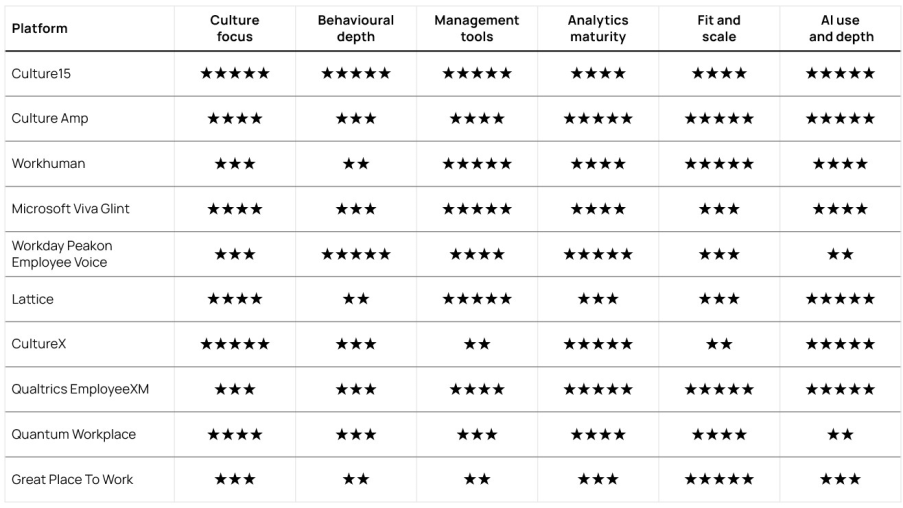
AI is now a standard feature across the category. The real differentiator is not whether a platform “uses AI”, but how AI changes what the platform can do: measuring and interpreting culture, reasoning across qualitative and quantitative data, and turning insight into context‑specific management action inside the tools where leaders and managers already work. For this reason, we assess AI integration and depth as a separate criterion, alongside culture specialism, behavioural depth, management capability, analytics maturity, and ecosystem fit and scale.
How did we chose the Top 10?
We evaluated culture and employee experience platforms against six criteria. Inclusion in the list required a clear positioning and a developed product for measuring and/or managing organisational culture or employee experience at scale.
Evaluation criteria:
- Culture focus: How much the solution focuses on culture, rather than general engagement or EX.
- Behavioural depth: To what degree does the solution focus on behaviours as the central axis of culture, linking these behaviours to strategy and results.
- Management tools: Whether the solution gives managers day-to-day support, such as interpretation support, playbooks, suggestions guides support.
- Analytics maturity: How good is the solution’s quantitative analytics, text analysis, segmentation and reporting?
- Fit and scale: Integrations, global reach and ability to support large complex companies.
- AI use and depth: How it uses AI to measure, explain and recommend actions for a specific context.
1) Culture15
Culture15 is a leading culture management platform that gives your business a common language to map, measure, modify and maintain the behaviours that drive financial performance. Built on more than two decades of consultancy experience, Culture15 is relied on by 80+ organisations in 59 countries.
Best suited to leadership teams that want to align culture with strategic goals, Culture15 measures and manages culture through shared, observable behaviours, rather than relying on engagement or sentiment scores in isolation. It uses one set of behaviour measures across five areas: how people interact, how decisions are made, how work gets done, where energy is focused, and how information flows.
Culture15’s AI assistant, Rose, turns dashboard data into practical steps for senior leaders, managers and people and culture teams. It helps them close the Culture Gap® between their current culture and their target culture, and build the behaviours needed to carry out strategy.
- Strengths: International user base, a specialist focus on observable behaviours, and a clear connection between culture and business strategy. Its AI assistant, Rose, helps leaders interpret culture data and turn it into practical action. It also decodes open-ended employee feedback in 30+ languages and transforms spoken and written responses into rich behavioural insight.
- Limitations: Culture15 is not a broad "employee experience suite" with performance reviews, goals and recognition baked in. It is a specialist culture analytics and management platform for organisations that treat culture as a strategic growth lever.
Culture15’s focus on behaviours, centrality of manager accountability and pioneering use of AI sets it aside from other offers. It is especially suited to organisations that want to manage culture with the same rigour and discipline as any other business priority.
2) Culture Amp
The top-ranked engagement-focused platform in our ranking, Culture Amp is a survey-first solution for employee engagement tracking and organisational development. It’s designed to connect feedback and performance insights to real change, using 15+ years of people science research and benchmarks built from 1bn+ survey responses. AI features include "Focus Agent", which helps managers read results and suggest actions.
- Strengths: A well-established global employee-experience platform used by organisations across multiple markets, with strong engagement, pulse and lifecycle surveys, benchmark data, manager dashboards and AI-supported action planning.
- Limitations: The approach is survey-first, meaning culture is mostly understood from engagement data and employee feedback. Progress depends on managers choosing to act on the results.
Culture Amp suits people teams that collect regular employee feedback and want ready-made action plans for their managers.
3) Workhuman
Workhuman is a global employee-recognition and employee-experience platform that uses peer-to-peer recognition, rewards and feedback to reinforce company values and strengthen workplace culture. Its Workhuman iQ capability analyses recognition data to provide insights into culture, collaboration, skills, performance and employee engagement
- Strengths: A global platform, with recognition, rewards, feedback, AI-powered insights and integrations with tools such as Microsoft Teams, Outlook, Slack and Workday. It helps organisations reinforce desired behaviours through everyday recognition and uses recognition data to identify cultural and performance patterns.
- Limitations: Its view of culture is shaped by recognition activity, so it is strongest at reinforcing values and behaviours that employees acknowledge rather than providing a comprehensive assessment of the organisation’s full behavioural culture. It may therefore be less suitable for organisations that want to compare their current culture with a target culture before deciding which behaviours need to change.
Workhuman is best suited to organisations that want to build a culture of recognition, reinforce company values, improve employee connection and use recognition data to understand patterns in behaviour and performance.
4) Microsoft Viva Glint
Microsoft Viva Glint is an employee listening platform within Microsoft's Viva tools. It connects with Teams, SharePoint and other Viva modules. It runs pulse surveys at scale and offers guided conversations for managers. It also allows organisations to gather feedback through surveys covering engagement, onboarding, exit, diversity and inclusion, digital transformation, and change management.
- Strengths: Glint is easy to adopt for Microsoft-first organisations. The platform benefits from their established global reach and deep integration with Microsoft 365, Teams, SharePoint and the wider Viva ecosystem, making it accessible to organisations already operating within Microsoft’s technology environment.
- Limitations: It is built around listening and engagement, rather than a specialist culture method or behavioural change. The platforms survey templates also offer limited customisation, restricting adaptation to specific organisational needs. Integration options with third-party software also limited.
Glint is a practical option for Microsoft 365 organisations that want regular feedback from team members built into everyday tools. It is best suited for large enterprises that want to track employee sentiment across vast, complex workforces.
5) Workday Peakon Employee Voice
Workday Peakon Employee Voice is an employee listening platform that links to Workday's company and HR data. It offers real-time listening, segmentation and people analytics.
- Strengths: A constant, real-time view of sentiment and key employee experience themes. It provides strong segmentation, targeted action plans and manager dashboards.
- Limitations: It is best for Workday customers. Its focus on sentiment and engagement means culture is interpreted primarily through patterns in employee feedback. User interface can be fiddly.
Peakon is a natural extension for Workday customers who want employee feedback connected to their HR data.
6) Lattice
Lattice is an all-in-one people platform. It combines ongoing performance management (reviews, 1:1s, feedback, goals and OKRs) with engagement surveys (pulse, onboarding, exit and eNPS). It delivers AI-powered insights that point out key drivers and next steps.
- Strengths: It is a single system for employee performance, productivity and engagement. People teams are able to link the two, for example to check whether high performers feel recognised and supported. It also makes career progression clear with functionality to host consistent and fair compensation reviews.
- Limitations: Culture measurement is a secondary benefit of the platform, so its capabilities are less specialised than those of a dedicated culture analytics and management solutions. It is focused on policies, career growth and reinforcing positive habits and less concerned about employee behaviour and interactions.
Lattice is built for organisations that want a single system for reviews, goals, feedback and engagement across their people work.
7) CultureX
The only other culture-specialist platform to make the list, CultureX is an AI-native culture intelligence platform. It studies large amounts of employee and company data that a business already holds, so there is no need to run surveys. It was founded to rigorously measure strategic agility and help companies win in turbulent markets. Their proprietary AI platform is built on decades of empirical research and has helped dozens of leading firms make their organisations measurably more agile and forms the basis of their benchmarking capability.
- Strengths: Strong use of academic research and AI to analyse existing employee and company data across large, complex organisations to provide benchmarks. It also provides detailed insights that help leaders spot patterns and decide where to step in.
- Limitations: Its global reach and effectiveness depend on the quality and volume of data available to each organisation, and it is strongest at diagnosing culture rather than providing day-to-day tools for changing behaviours.
CultureX is a fit for data-rich organisations that want an early read on where culture problems sit, with other teams or tools to act on what it finds.
8) Qualtrics EmployeeXM
Qualtrics EmployeeXM is an experience management platform that links employee data to customer and brand experience. It offers advanced statistical models, Text iQ for analysing open-text comments, and predictions. It is built for large, complex organisations that run programmes across many teams and locations.
- Strengths: A globally established enterprise platform with the scale and deepest analytics capabilities in this list. It provides flexible surveys, complex segmentation and strong visual reports.
- Limitations: Very powerful but can be overly complex, and needs a dedicated EX team or analytics expert to use. The platform also does not have a built-in management layer for changing culture, being more focused on closing the gap between feedback and action, rather than your current culture (where you are now) and target culture (where you want to be).
Qualtrics is hard to beat on analytics. It is a strong contender for large organisations with the people and time to run multi-year EX programmes.
9) Quantum Workplace
Quantum Workplace is all‑in‑one HR and talent management platform that brings engagement, culture measurement and performance and development tools together in one place. It offers research-backed surveys to help organisations build better managers, identify top talent, and retain the best people.
- Strengths: Has strong driver analysis and helps organisations connect employee experience data with people outcomes across their workforce.
- Limitations: Its survey-led model means that its value depends on the quality of the data collected and the organisation’s ability to act on the finding. Workplace culture is primarily associated with how “engaged” their employees are, rather than how work gets done.
Quantum Workplace is a solid all-rounder for survey-led teams that want to see how engagement, recognition and performance connect.
10) Great Place To Work
Great Place To Work combines employee surveys with a certification programme that is recognised around the world. Its Trust Index™ Survey asks about individual employees' experiences of five parts of a high-trust culture. It uses 60 statements and two open questions. Certification is earned through confidential employee feedback and is backed by more than 30 years of research.
- Strengths: Highly recognised international brand, a presence across global markets and an extensive research base. They certificate organisations against an external benchmark, which widely signals the state of workplace culture.
- Limitations: Primarily built for benchmarking and outside recognition, rather than day-to-day culture change. It has limited management tools for changing how teams work.
Great Place To Work is useful for organisations that want independent proof to support their employer brand and build trust.
How to choose the right culture management platform?
The best platform depends on what you want to achieve. If your priority is actively managing culture through observable behaviours and aligning it with business strategy, Culture15 is the strongest choice; the other platforms are better suited to employee listening, advanced analytics or broader people management.
If you want to manage culture, choose Culture15
Choose Culture15 if you want to understand whether the behaviours across your organisation are helping or hindering business performance, and then take practical action to change them. Unlike platforms that stop at engagement scores or culture dashboards, Culture15 measures observable behaviours, identifies the gap between your current and target culture, and helps leaders track progress towards closing that gap. Its AI assistant, Rose, interprets quantitative and qualitative culture data, explains what is happening and why it matters, and recommends practical next steps for leaders and managers, creating a clear route from culture insight to interpretation to action. This makes Culture15 particularly valuable during transformation, post-merger integration, rapid growth or strategic change.
If you want employee listening, choose Culture Amp
Choose Culture Amp if you want to build a regular listening programme that captures employee views through engagement, pulse and lifecycle surveys. Its benchmark data, manager dashboards and action-planning tools help people teams identify engagement drivers, understand how different groups are experiencing the organisation and give managers practical guidance on where to focus. Culture Amp is particularly useful for organisations that want to monitor employee sentiment over time, compare results across teams or locations and support managers in responding to feedback.
If you want advanced employee-experience analytics, choose Qualtrics
Choose Qualtrics if you want to understand the full employee experience across the employee lifecycle, from onboarding and development to promotion and exit, across a large, complex or geographically distributed organisation. Qualtrics can also connect employee-experience data with operational information, such as performance, attrition and customer-experience data, helping organisations understand which employee experiences may be affecting productivity, retention or customer outcomes. It is particularly valuable for organisations running large-scale, multi-year employee-experience programmes that require detailed reporting and extensive customisation.
If you want an all-in-one people platform, choose Lattice
Choose Lattice if you want to bring performance management, employee development and engagement into one connected platform. It combines performance reviews, one-to-ones, feedback, goals, OKRs, career development, compensation reviews and engagement surveys, helping people teams connect employee experience with performance and progression. Lattice is particularly useful for organisations that want to create consistent people processes, give managers a shared view of employee performance and support career growth through one system.
2026 Culture Management Platform Tracker